

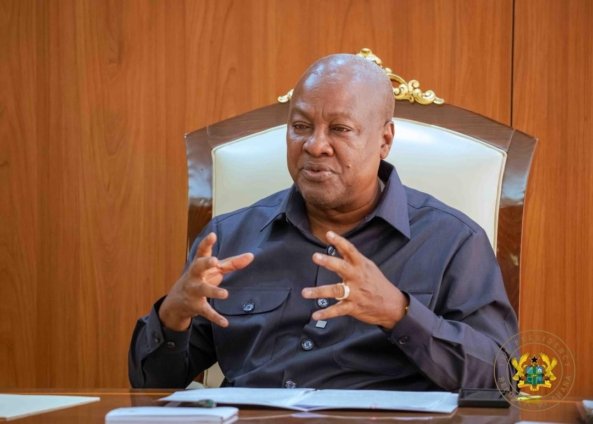
President John Dramani Mahama has delivered a stinging critique of the nation’s previous SIM card registration drive, describing it as a failed project that imposed unnecessary hardships on Ghanaians without ensuring data integrity.
Speaking in Sunyani during his “Resetting Ghana” tour on Thursday, 19th March 2026, the President argued that the earlier exercise lacked credibility due to a fundamental breakdown in inter-institutional cooperation.
The President’s remarks coincide with a startling revelation from the National Communications Authority (NCA).
A recent audit of SIM data collected between 2021 and 2023 reportedly found zero fingerprint matches when cross-referenced with the national identity database, a discovery that effectively renders the previous registration cycle moot.
President Mahama attributed this failure to a lack of coordination between the Ministry of Communications and the National Identification Authority (NIA).
“If you recall, we were asked to re-register our SIM cards, and the process was very challenging. There was a disconnect between the authorities responsible, and in the end, it did not benefit Ghanaians. It was largely ineffective,” the President stated.
To rectify these “shortcomings”, the President outlined a new strategy that prioritises the Ghana Card as the sole, verified anchor for all mobile subscriptions. Unlike the previous process, which was marred by long queues and technical glitches at physical centres, the proposed system aims for a digital-first approach.
Key features of the new plan include:
- Full Integration: A seamless link between the NCA and the NIA to ensure every SIM is tied to a verified identity.
- Remote Updates: A new system allowing citizens to update registration details digitally, removing the need for physical presence at registration points.
- Data Integrity: Ensuring that biometric data matches the national database in real-time to curb cybercrime and identity theft.
President Mahama emphasised that the upcoming exercise would be designed with user convenience in mind. He assured the public that the “Resetting Ghana” agenda would replace bureaucratic hurdles with efficient technology, ensuring that the next registration is the final, definitive one.
The President’s stance signals a major shift in digital policy, as the government moves to restore public trust in the country’s telecommunications infrastructure following the audit’s embarrassing findings.