Majority: Bank of Ghana’s GH¢19bn Loss Reflects Cost of Economic Stabilisation Efforts
Credit: citinewsroom

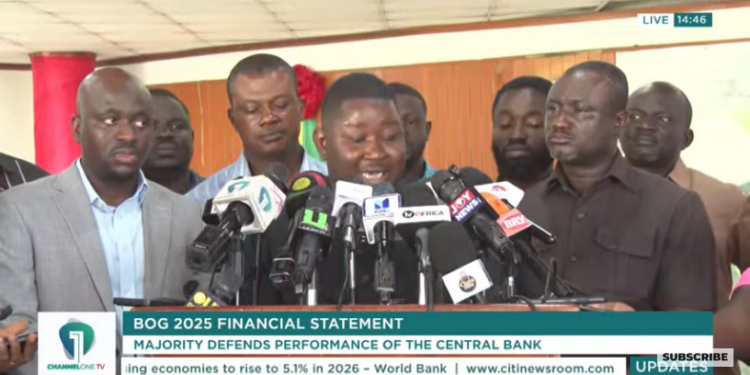
The majority in parliament has said that the much-publicised GH¢19 billion loss recorded in the Bank of Ghana’s 2025 financials must be understood within the context of deliberate policy actions that have stabilised the economy.
According to them, the figure does not represent waste or mismanagement, but rather the cost of interventions that have produced tangible economic gains.
Speaking in defence of the central bank’s performance in 2025, the majority argued that the Bank of Ghana had to absorb high financial costs to achieve lower inflation, a stronger currency, and improved macroeconomic stability.
Speaking on behalf of the majority on Thursday, April 30, 2026, the Member of Parliament for Sagnarigu, Atta Issah, said the outcomes being experienced by Ghanaians today are directly linked to those policy decisions.
“The costs you see in the financial statements are the costs of producing the outcomes that you are living through currently. The institution carried them on its books; the country received the benefits.”
He explained that one of the major cost drivers was the aggressive effort to tame inflation, which required the central bank to absorb excess liquidity from the financial system.
“To bring inflation down, the bank had to absorb excess money from the banking industry by issuing short-term bills and paying interest on them. The cost rose from about GH¢8.6 billion in 2024 to GH¢16.7 billion in 2025.”
Mr Issah noted that the increased spending yielded significant results, with inflation dropping sharply.
“The bigger you spend, the bigger your results. In 2025, with a larger spend, inflation fell by eighteen percentage points. The cost was real, and the result was real as well.”
He further pointed to the Bank’s gold purchase programme as another key factor behind the headline cost, explaining that the initiative was instrumental in building Ghana’s reserves.
“The accounting cost of the gold purchase programme stood at GH¢9 billion in 2025. The programme accumulated approximately 111 tons of gold. The gold itself has not been lost. The reserves are real.”
Addressing concerns about the reported GH¢19 billion loss, the majority cautioned against misinterpretation, insisting that part of the figure reflects accounting adjustments rather than actual financial losses.
“What we suffered because of our strong management of the currency resulted in a loss. This is a mirror image of the gain the bank recorded when the Cedi was weakening.”
He argued that a weaker currency would have produced the opposite effect in the books, but at the expense of ordinary citizens.
“A weaker Cedi would have produced an accounting gain and a higher inflation for the ordinary Ghanaian. The right thing happened.”
The majority maintained that the Bank of Ghana’s actions, though costly, have created a buffer for the economy to withstand global shocks, insisting that the benefits outweigh the financial implications recorded in its accounts.