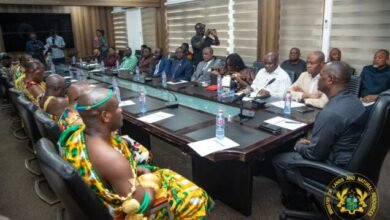
PAC Calls for Annual Government Arrears Audits to Tackle Financial Irregularities
Credit: myjoyonline


The Public Accounts Committee (PAC) of Parliament has called on the Ministry of Finance to consider conducting annual audits of government arrears claims, rather than waiting until the end of a government’s tenure.
The call was made by the Chairperson of the Committee, Abena Osei Asare, at the end of a zonal hearing in Ada.
Addressing concerns over recurring infractions highlighted in Auditor-General’s reports over the years, Mrs Osei Asare expressed worry about persistent lapses in public financial management.
She noted that common infractions in the public service include unsupported expenditures, procurement breaches, weak internal controls, delayed retirement of imprests, payroll irregularities, and, in some instances, the deliberate falsification of invoices and claims.
“The Committee remains deeply concerned about recurring infractions within the public service, including unsupported expenditures, procurement breaches, weak internal controls, delayed retirement of imprests, payroll irregularities, and, in some instances, the deliberate falsification of invoices and claims,” she said.
She stressed that these challenges go beyond accounting errors and have wider implications for public trust in state institutions.
“These issues are not merely accounting errors; they undermine public trust and weaken confidence in state institutions,” she added.
Mrs Osei Asare reiterated that accountability in public service begins long before officials appear before oversight committees.
“We therefore wish to remind all public servants that accountability begins long before one appears before the Public Accounts Committee,” she stated.
She explained that accountability must be embedded in every stage of the financial process, from decision-making and documentation to procurement, certification and payment approval.
“It begins at the point of decision-making, documentation, procurement, certification and payment approval,” she noted.
She further emphasised the need for renewed responsibility among public officers in the management of state resources.
“Every public officer must appreciate that public funds are sacred. The future of public financial management in Ghana will depend not only on laws and systems, but also on personal integrity, ethical leadership and professionalism within the civil service and public institutions,” she said.
Mrs Osei Asare also urged the Ministry of Finance to strengthen capacity-building programmes for public officials involved in expenditure management.
“The Ministry of Finance is encouraged to find cost-effective means of training all public spending officers, as well as middle-level officials, in the requirements of the revamped Public Financial Management Act,” she added.
She argued that conducting special audits annually, rather than only at the end of a government’s tenure, would help reduce financial excesses and improve accountability.
Mrs Osei Asare further stressed that greater transparency in arrears management would strengthen fiscal credibility, enhance expenditure control and reduce the need for repeated special audits.