
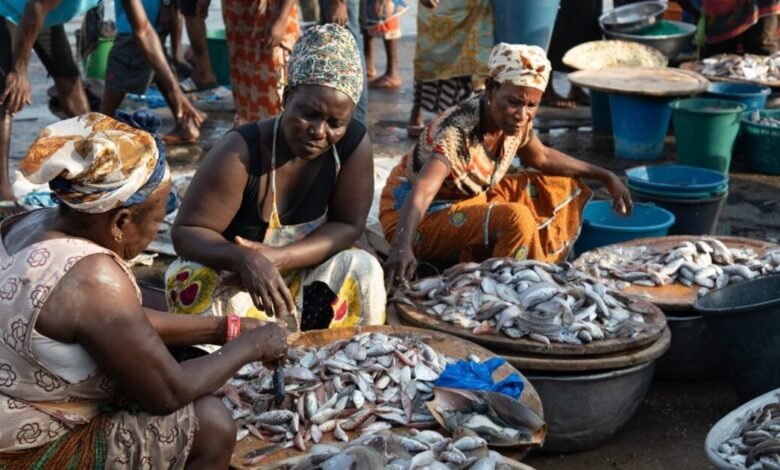
The growing practice of light fishing along Ghana’s coastline is not only threatening the country’s marine resources but is also worsening the economic vulnerability of women whose livelihoods depend heavily on the fisheries sector.
For many women engaged in fish processing, smoking, drying and trading, declining fish catches have translated into shrinking incomes, mounting debts and growing uncertainty. Some say the persistent use of light fishing and other destructive fishing practices is making it increasingly difficult to sustain their businesses and families, with irregular migration emerging as a desperate option for some members of fishing communities seeking better economic opportunities elsewhere.
The concerns emerged during a tour of selected landing beaches in the Central Region, including Moree, Elmina and Cape Coast (Abrofo Mpoano), with support from Journalists for Responsible Fisheries and Environment (JRFE).
The interactions offered a sobering picture of the socio-economic consequences of declining fish stocks and the pressure it places on women, who form the backbone of Ghana’s post-harvest fisheries value chain.
Declining Fish Stocks, Declining Incomes
Women at the landing beaches recounted how the fisheries business has become increasingly difficult as fishermen return from sea with significantly smaller catches than in previous years.
With fish becoming scarce, competition among buyers has intensified. Traders are often forced to pay higher prices to secure limited quantities, only to struggle to make meaningful profits when the fish are sold.
“We depend entirely on fish landed at the beaches to feed our families and keep our businesses alive,” one fish processor said. “Today, we borrow money just to buy fish, but after selling, we cannot recover our capital. The debts keep increasing.”
For women whose businesses depend almost entirely on daily fish landings, every reduction in catch represents a direct reduction in income.
The consequences extend beyond the women themselves. Household nutrition, children’s education, healthcare and other basic needs are increasingly being affected as families struggle to cope with declining earnings.
Light Fishing Worsening the Crisis
Fishers attributed much of the decline in fish stocks to the continued use of light fishing, a prohibited fishing method in which powerful lights are used at night to attract fish before they are harvested.
According to fishers, the practice contributes to the capture of juvenile fish before they mature and reproduce, thereby threatening the sustainability of fish populations.
They also contend that destructive fishing methods disrupt the natural marine ecosystem and accelerate the depletion of already-stressed fish stocks.
As catches decline, artisanal fishermen are compelled to spend longer periods at sea and travel farther in search of fish, often returning with little to show for the fuel, time and effort invested.
For women involved in processing and trading, the effects are immediate.
A smaller landing means fewer fish to process and sell, reduced turnover and less money available to meet household expenses or repay loans.
Debt Becoming a Way of Life
Ama Nyamekyera, a 36-year-old fish processor from Moree with more than 15 years of experience in the fishing industry, described the growing financial difficulties confronting women in the sector.
She explained that access to credit has become increasingly important for fish processors who need capital to purchase fish when they are landed.
According to her, women commonly obtain credit from canoe owners, fish suppliers, savings groups, microfinance institutions and informal lenders.
Although she said she has personally managed to avoid taking loans due to the support of her fisherman husband and family, she observed that many of her colleagues depend heavily on credit to keep their businesses operating.
The problem, she said, is that declining profits have made it increasingly difficult for some women to meet repayment schedules.
The accumulated debts have, in some cases, forced families to sell household assets, temporarily withdraw children from school, postpone healthcare and reduce the number of meals they can afford.
Others live under constant pressure from creditors, creating emotional distress and uncertainty about their future.
“We are working harder than before but earning less,” another female fisher lamented. “Every day we think about how to pay those we owe.”
Fishermen Also Bearing the Cost
The economic consequences of destructive fishing practices are not limited to women.
Joel Eyifah, a 40-year-old fisherman with about 20 years of experience in the fishing industry, explained that fishermen who rely on traditional methods and “man-power” fishing also suffer when destructive practices become widespread.
He said fishermen who do not engage in light fishing can return from sea after spending considerable amounts on fuel and labour without making a meaningful catch.
According to him, they may also return with damaged nets and other equipment, further increasing their financial losses.
Mr. Eyifah argued that light fishing can create an uneven fishing environment in which some fishers harvest large quantities in a particular area, leaving little for other canoes operating nearby.
He said the resulting depletion makes it increasingly difficult for fishermen using conventional fishing methods to secure adequate catches, deepening the financial difficulties faced by fishing families.
Irregular Migration Emerging as an Escape
For some women and young people in fishing communities, the collapse of traditional livelihoods is creating pressure to look beyond Ghana for economic opportunities.
Fishers said stories of relatives and friends who have travelled abroad and found employment can encourage others to consider migration, particularly when they are struggling with unemployment, poverty and debt.
For indebted women, the prospect of earning stronger incomes abroad can appear attractive because it offers the possibility of repaying loans, supporting children and improving household living conditions.
However, migration expert Ruth Mansah Mensah of GIZ-Ghana warned that travelling through irregular migration channels can expose migrants to serious risks.
She explained that people who migrate through unsafe or irregular routes may become vulnerable to exploitation, modern slavery, human trafficking, forced labour, gender-based violence and other forms of abuse.
According to Ms. Mensah, migrants who leave under financial pressure or indebtedness can be particularly vulnerable because their desperation may be exploited by traffickers and other unscrupulous actors.
She noted that some migrants can become trapped in exploitative employment or debt bondage, effectively losing control over the work they perform and the conditions under which they live.
Ms. Mensah therefore urged women and other prospective migrants to seek accurate information about safe and regular migration pathways before making decisions that could expose them to exploitation.
She also called for stronger local economic opportunities so that migration becomes a genuine choice rather than an escape from poverty and indebtedness.
Women’s Livelihoods at Stake
Prof. Isaac Okyere of the Africa Ocean Institute at the University of Cape Coast (UCC) observed that women are among the hardest hit by declining fisheries because of their dominant role in Ghana’s post-harvest fisheries sector.
Women play major roles in fish smoking, drying, processing, transportation and marketing across coastal communities.
Consequently, declining fish supplies have a ripple effect across entire communities.
When fewer fish are landed, processors have less stock to work with, traders lose income, households struggle to meet basic needs and local economic activity declines.
The effects can also reach children, particularly where parents depend on fish-related businesses to finance school fees, food, healthcare and other household necessities.
Prof. Okyere warned that without decisive measures to rebuild depleted fish stocks, more women could become trapped in cycles of debt, unemployment, poverty and migration.
Ghana’s Fisheries Under Long-Term Pressure
Prof. Okyere noted that Ghana’s fisheries have been under increasing pressure from overfishing since the 1990s and early 2000s.
He said the depletion of fish stocks has made it increasingly difficult for fishermen to achieve the levels of catch that were previously possible.
He cautioned that the continued use of illegal and destructive fishing methods, including light fishing, could further undermine the country’s marine resources and threaten the future of the fisheries sector.
The situation, he said, requires proactive and sustained measures rather than temporary interventions.
Calls for Stronger Enforcement
Fishers and stakeholders called on the Government, the Fisheries Commission and law enforcement agencies to intensify efforts to combat light fishing and other destructive fishing practices.
They stressed the need for effective monitoring, consistent enforcement of Ghana’s fisheries laws, prosecution of offenders and measures to prevent political interference in the enforcement process.
They also called on traditional authorities, fisher associations, community leaders and civil society organisations to intensify public education on the long-term consequences of illegal fishing.
Stakeholders emphasised that enforcement alone would not be sufficient.
They called for expanded access to affordable credit, business support, vocational training and alternative livelihood programmes for women whose incomes depend on fishing.
Investments in aquaculture, fish value addition, agro-processing and other sustainable businesses were identified as potential avenues for creating more stable sources of income.
Protecting the Blue Economy
The crisis confronting fishing communities demonstrates that protecting Ghana’s marine resources is not merely an environmental responsibility; it is also an economic and social necessity.
For millions of people whose livelihoods depend directly or indirectly on fisheries, the health of the ocean determines whether families can earn an income, put food on the table and keep children in school.
Combating light fishing and other destructive practices could therefore have benefits beyond restoring fish stocks.
A healthier marine ecosystem could improve fish landings, strengthen household incomes, create more opportunities for women and reduce some of the economic pressures that contribute to risky migration decisions.
The challenge, however, requires coordinated action involving government agencies, law enforcement institutions, traditional authorities, fisherfolk, women’s groups, civil society organisations, development partners and the media.
Media’s Role in Driving Solutions
The media has a critical role to play in exposing and addressing the connection between illegal fishing, declining livelihoods, mounting debt and irregular migration.
Journalism must move beyond simply reporting the consequences of illegal fishing and migration to investigating the structural causes of the crisis and examining possible solutions.
Through sustained investigative and solutions-oriented reporting, the media can amplify the voices of affected women, scrutinise weaknesses in fisheries enforcement, investigate the economic impact of declining fish stocks and highlight interventions that are delivering results.
The media can also provide platforms for female fishers, policymakers, traditional authorities, fisheries experts, civil society organisations, financial institutions and migration experts to engage in meaningful discussions about practical solutions.
Giving affected women a stronger voice in these conversations is particularly important because they understand firsthand the economic realities confronting fishing communities.
Reporting on irregular migration must also avoid sensationalism and stigmatisation.
Women who migrate because of economic hardship should be treated with dignity, while journalists should examine the broader economic and social conditions influencing their decisions.
Solutions journalism can further track government and development interventions after they are announced, asking critical questions about whether promised livelihood programmes are reaching their intended beneficiaries, whether women are receiving adequate support and whether those interventions are producing sustainable outcomes.
Protecting Livelihoods, Restoring Hope
For generations, Ghana’s coastal communities have depended on the sea for food, income and survival.
For many women, the fisheries value chain has provided a means of supporting families, educating children and building economic independence.
But declining catches, rising operational costs and destructive fishing practices are threatening that foundation.
Their stories provide a powerful reminder that protecting Ghana’s marine resources is inseparable from protecting the livelihoods and dignity of the women who sustain the fisheries value chain.
Addressing light fishing is therefore not only about conserving fish.
It is about restoring livelihoods, rebuilding coastal economies, protecting food security and ensuring that economic desperation does not push vulnerable women and young people towards dangerous irregular migration routes.
The future of Ghana’s blue economy will ultimately depend on whether the country can protect its marine resources while creating viable economic opportunities for the communities that depend on them.
For the women standing at Ghana’s landing beaches today, the message is clear: saving the fishery means saving livelihoods—and, for some families, restoring a future worth staying for.