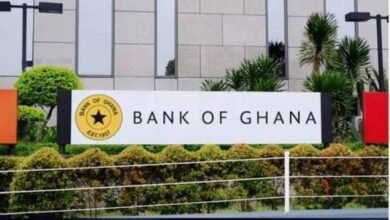


The Governor of the Bank of Ghana (BoG), Dr Johnson Asiama, has explained that the recently introduced directives on mobile money transaction limits form part of broader regulatory measures aimed at strengthening security, combating fraud and addressing growing cybersecurity threats in Ghana’s financial sector.
According to him, the revised framework introduces changes to subscriber and merchant transaction limits, establishes limits for agents for the first time and imposes monthly transaction ceilings across all mobile money wallets.
Dr Asiama explained that the new limits are linked to Know Your Customer (KYC) verification levels, ensuring that customers who transact higher amounts are subject to more comprehensive identification requirements.
“Each limit is tied to KYC [Know Your Customer] tiers, so where more money moves, we know more about who is moving it,” he stated.
The BoG Governor made these remarks at the Chartered Institute of Bankers’ Governor’s Day Dinner held at the Labadi Beach Hotel in Accra.
He noted that although the digital revolution in the financial sector had created unprecedented opportunities for economic growth, financial inclusion and operational efficiency, it had also introduced new risks that required stronger regulatory oversight.
“It has brought a new frontier of risk, a complex, ever-evolving cyber threat landscape that tests the resilience of our institutions and the trust of the public we serve,” Dr Asiama said.
He further assured stakeholders that the Bank of Ghana’s vision extends beyond the narrow concept of maintaining financial stability.
He explained that the central bank seeks to build a financial system characterised by well-capitalised commercial banks, strong corporate governance, technological resilience and the capacity to support the productive transformation of the Ghanaian economy.
New Mobile Money Transaction Limits
The revised directives, which took effect on November 24, 2026, introduced monthly transaction ceilings for mobile money customers, with the limits determined by their respective KYC categories.
Under the new framework, Medium KYC customers can maintain a maximum wallet balance of GH¢40,000 and transact up to GH¢15,000 daily, subject to a monthly transaction ceiling of GH¢150,000.
For Enhanced KYC customers, the maximum wallet balance remains GH¢75,000, while the daily transaction limit is maintained at GH¢25,000. However, their total monthly transactions must not exceed GH¢300,000.
Meanwhile, customers under the Minimum KYC category will retain their existing limits of GH¢5,000 for wallet balances, GH¢3,000 in daily transactions and GH¢10,000 in monthly transactions.
The introduction of monthly transaction ceilings represents a significant change from the previous arrangement, under which Medium and Enhanced KYC customers were not subject to specified monthly transaction limits.
The review forms part of the Bank of Ghana’s broader efforts to strengthen financial stability, improve accountability and enhance the security of Ghana’s digital financial services. The directives apply to all Dedicated Electronic Money Issuers (DEMIs) operating in the country.
Mobile Money Fintech Limited Assures Customers
Meanwhile, Mobile Money Fintech Limited has assured customers that the regulatory changes will not affect funds already held in their mobile money wallets.
The company also indicated that merchants and agents would be directly informed about the revised transaction limits applicable to their respective accounts.
It described the changes as significant steps in the right direction, adding that mobile money operators and other stakeholders in the financial technology ecosystem were working towards implementing the new requirements.
Mobile Money Fintech Limited further reaffirmed its commitment to collaborating with the regulator to ensure a sustainable fintech environment that supports all players in the ecosystem and promotes the continued growth of Ghana’s digital financial services industry.
The new measures are expected to strengthen oversight of mobile money transactions while addressing emerging risks associated with fraud, cyberattacks and the rapid expansion of digital financial services in Ghana.
Visit NewsAfricaGhana.com for more news and updates.