When Dialogue Fails: Is Strike Action the Only Way to Get Government’s Attention?
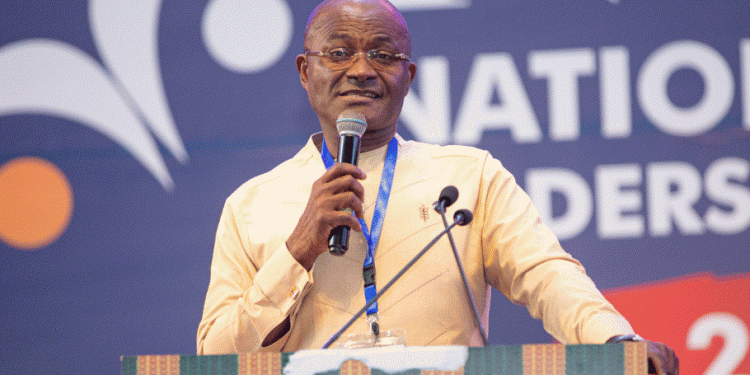
Credit: myjoyonline


Ghana appears to be gradually developing a troubling culture in which workers must threaten to withdraw their services before their grievances receive the attention they deserve. Negotiated agreements are reached, assurances are given, deadlines are announced, and expectations are raised. Yet, in too many instances, implementation becomes another prolonged struggle. Eventually, patience wears thin, trust deteriorates, and industrial action becomes the final instrument through which workers seek to enforce their rights.
This raises a fundamental question that deserves national reflection: Has industrial action become the only language successive governments in Ghana understand?
It is an uncomfortable question, but one that cannot be dismissed as mere frustration. The recurring industrial disputes across Ghana’s public sector point to deeper concerns about institutional accountability, respect for negotiated agreements, labour relations and the credibility of government commitments.
The issue is not simply that workers are demanding improved remuneration or better conditions of service. Rather, it is that some workers find themselves repeatedly fighting for entitlements that have already been negotiated, agreed upon or contractually earned. This distinction is important. There is a significant difference between demanding new benefits and demanding the implementation of existing obligations.
The Recurring Cycle of Industrial Actions
Recent developments in Ghana’s education sector provide a compelling illustration of this problem.
On 1 October 2026, the Technical University Teachers’ Association of Ghana (TUTAG) commenced an indefinite industrial action following unresolved concerns over post-retirement contractual remuneration, the implementation of the agreed Scheme of Service and the treatment of academic librarians.
According to the Association, some lecturers who continued serving their institutions under post-retirement contracts had not received their contractual remuneration for as long as 27 months. TUTAG also raised concerns about administrative changes affecting the career progression of Assistant Lecturers and Assistant Research Fellows.
These concerns raise serious questions about fairness, administrative responsibility and respect for contractual obligations.
How does a public institution benefit from the services of an academic for more than two years without settling the remuneration reportedly due to that individual? What message does this send to younger academics who are expected to dedicate their professional lives to teaching, research and national development?
Equally concerning is the situation in pre-tertiary education, where the Ghana National Association of Teachers (GNAT), the National Association of Graduate Teachers (NAGRAT) and the Pre-Tertiary Teachers Association of Ghana (PRETAG) embarked on industrial action over promotion-related arrears, allowances and outstanding conditions of service.
Although these unions suspended their strike on 9 October 2026 following government engagements, their leadership indicated that negotiations would continue because the outstanding issues had not been fully resolved.
These developments suggest a recurring pattern: grievances accumulate, negotiations proceed slowly, workers issue ultimatums, industrial actions follow, and government intensifies its engagement.
One is therefore compelled to ask why the same urgency often appears difficult to achieve before industrial action is declared.
When Negotiated Agreements Lose Their Meaning
Collective bargaining is an essential component of modern industrial relations. It provides an organised framework through which employers and employees negotiate remuneration, working conditions, professional development and other employment matters.
However, the effectiveness of collective bargaining depends not merely on reaching agreements but on implementing them.
An agreement that remains unimplemented is of limited practical value to the worker whose livelihood depends on it.
From the perspective of Social Exchange Theory, employment relationships are sustained by reciprocal obligations. Workers contribute their knowledge, time, skills and professional commitment, while employers are expected to provide agreed remuneration, fair treatment and a conducive working environment.
When these expectations are repeatedly frustrated, the relationship between employer and employee becomes strained.
The consequences extend beyond financial dissatisfaction. They include declining organisational commitment, weakened morale, distrust of leadership and reduced confidence in established institutional processes.
This is particularly troubling in the public sector, where government is expected not only to enforce labour laws but also to demonstrate exemplary compliance with employment obligations.
If government institutions cannot consistently honour their own negotiated commitments, what moral authority do they have to demand strict compliance from private employers?
The Government Must Also Be Heard
A balanced discussion must acknowledge that governments operate within fiscal constraints. Public expenditure must be managed against competing national priorities, including infrastructure, healthcare, education, debt obligations and other essential services.
It would therefore be unrealistic to assume that every labour demand can be satisfied immediately.
However, financial constraints should not become a permanent justification for delayed implementation of agreements.
Where government cannot meet an obligation within an agreed period, responsible governance requires early communication, transparent explanations, realistic payment arrangements and credible implementation timelines.
The difficulty arises when workers are repeatedly assured that their concerns will be addressed, only for those assurances to remain unfulfilled.
The question is not whether government faces financial limitations. Every government does. The question is whether those limitations are being managed transparently, predictably and in good faith.
Workers deserve more than assurances that are renewed whenever a strike threatens essential public services.
Industrial Action: A Right or an Unfortunate Necessity?
Industrial action remains an important instrument in labour relations. Ghana’s Labour Act, 2003 (Act 651), provides a framework for resolving industrial disputes through negotiation, mediation and arbitration, as well as regulating strikes and lockouts.
Ideally, industrial action should arise only after reasonable efforts at dispute resolution have failed and applicable legal requirements have been observed.
Unfortunately, when workers repeatedly experience delayed implementation of negotiated agreements, strikes may increasingly be perceived as the most effective means of securing attention. This is a dangerous development for industrial relations.
A system in which workers believe that dialogue produces promises while strikes produce action risks encouraging confrontation rather than cooperation.
Nevertheless, workers should not automatically be portrayed as unreasonable whenever they embark on industrial action. Their grievances must be examined on their merits, including the extent to which employers have fulfilled existing obligations.
At the same time, unions must remain mindful of the wider consequences of withdrawing essential services and continue to pursue lawful, proportionate and constructive approaches to resolving disputes.
Industrial harmony cannot be achieved by demanding sacrifices from workers while overlooking the responsibilities of employers.
The Silent Victims: Students and National Development
The consequences of industrial actions are not confined to workers and government.
In the education sector, students often become the unintended victims of prolonged labour disputes.
Lectures are interrupted, examinations may be postponed, academic supervision is affected, and institutional calendars become uncertain. In some circumstances, these disruptions delay graduation and the transition of students into productive employment.
Parents and guardians who have invested substantial resources in their children’s education are equally affected.
For Ghana’s technical universities, the implications are particularly significant.
Technical universities occupy a strategic position in the country’s human capital development agenda. They are expected to produce technically competent graduates, support applied research, promote innovation and strengthen collaboration between academia and industry.
These institutions contribute to the development of engineers, construction professionals, technologists, entrepreneurs and other skilled personnel required for national industrialisation.
Repeated disruptions to their academic activities therefore threaten more than institutional stability. They potentially weaken the human resource development system upon which Ghana’s economic transformation depends.
How can a nation consistently pursue industrialisation, technological advancement and economic competitiveness while the institutions responsible for producing its technical workforce experience recurring labour instability?
The answer cannot be found in blaming lecturers for defending their employment rights or dismissing students’ frustrations. It must be found in addressing the institutional weaknesses that allow avoidable disputes to escalate.
Where Is the Institutional Accountability?
Ghana has established institutions responsible for managing labour relations, including the National Labour Commission, the Fair Wages and Salaries Commission and the relevant ministries and regulatory agencies.
The existence of these institutions should ordinarily provide sufficient mechanisms for preventing and resolving many industrial disputes before they result in strikes.
Yet recurring disagreements over negotiated conditions, remuneration and implementation timelines raise legitimate questions about the effectiveness of coordination and enforcement.
Are agreements being concluded without adequate budgetary provisions? Are responsibilities clearly assigned to implementing institutions? Are delays communicated promptly to affected workers? What mechanisms exist to hold public institutions accountable when commitments are not fulfilled?
These questions deserve serious consideration.
There is also a need to distinguish between negotiating an agreement and possessing the administrative and financial capacity to implement it.
Where implementation requires the involvement of multiple government agencies, poor coordination can create delays even after the substantive issues have been settled.
Such administrative difficulties should not become the burden of workers who have already fulfilled their professional responsibilities.
A credible industrial relations system must provide effective mechanisms not only for negotiating agreements but also for monitoring their implementation.
From Crisis Management to Responsible Governance
Ghana must move away from an approach to industrial relations that appears excessively reactive.
It is neither economically sustainable nor administratively responsible for government attention to intensify principally when workers threaten industrial action.
A more effective approach requires several reforms.
First, negotiated agreements should be accompanied by clear and realistic implementation schedules, identifying responsible institutions, funding arrangements and deadlines.
Second, government should strengthen coordination among the Ministry of Finance, Ministry of Employment, Ministry of Education, the Fair Wages and Salaries Commission and other relevant agencies to minimise administrative delays.
Third, mechanisms for monitoring compliance with negotiated agreements should be strengthened. The National Labour Commission must be adequately supported to discharge its statutory responsibilities effectively.
Fourth, government and labour unions should institutionalise regular engagement that goes beyond crisis meetings convened when strikes become imminent.
Finally, public-sector labour relations must be guided by transparency, mutual respect and accountability. Where commitments cannot be fulfilled within agreed timelines, the reasons should be communicated honestly and revised arrangements negotiated in good faith.
These measures would not eliminate all industrial disputes. However, they could significantly reduce conflicts arising from avoidable delays, poor communication and unfulfilled commitments.
A National Problem That Transcends Political Administrations
It would be intellectually dishonest to suggest that Ghana’s industrial relations challenges began with the present administration.
Successive governments have confronted disputes involving teachers, university lecturers, healthcare professionals, public-sector employees and other organised labour groups.
The persistence of such disputes suggests that Ghana must examine the structural and institutional weaknesses underlying public-sector employment relations rather than viewing each strike solely through a partisan political lens.
Governments change, but the institutions of the state remain.
Consequently, commitments lawfully undertaken by public institutions must be treated with the seriousness necessary to sustain continuity, credibility and public confidence.
Industrial relations should not become a contest in which workers are expected to demonstrate loyalty through indefinite patience while government demonstrates commitment through repeated assurances.
The relationship must be founded on mutual obligations.
Conclusion:
Must Ghana Always Wait for a Strike?
A nation cannot build strong institutions on promises that are repeatedly made but inadequately implemented. Neither can it achieve sustainable development when industrial harmony depends primarily on the ability of workers to disrupt public services.
The recurring industrial actions in Ghana should therefore serve as a wake-up call to government, labour unions, public institutions and policymakers.
The central issue is not simply how quickly government can persuade striking workers to resume their duties. It is how effectively government can address the underlying grievances and prevent similar disputes from recurring.
For TUTAG and other labour unions, the demand for respect for negotiated agreements and earned contractual entitlements raises fundamental questions of fairness and institutional accountability.
For government, the challenge is to demonstrate that dialogue can produce timely, credible and measurable outcomes without the disruption of industrial action.
For the nation, the responsibility is to develop an industrial relations framework that protects workers’ rights while safeguarding education, productivity and national development.
Ghana must reach a point where agreements are honoured because they are binding commitments, not because workers have withdrawn their services.
Until that becomes the norm, the troubling question will persist:
Is industrial action the only language government understands?
And perhaps the more important question is this: What will it take for government to listen before workers are compelled to strike?
About the Author
Dr. Isaac Aidoo is a Senior Lecturer and Head of the Building Technology Department at Accra Technical University. His academic interests include construction management, institutional resilience, sustainability and organisational performance. The views expressed in this article are his personal views.
Editorial notes before submission
The article is grounded in reports from the Ghana News Agency, MyJoyOnline and Ghana’s Labour Act, 2003 (Act 651). Particularly relevant sources are the GNA report on TUTAG’s strike and MyJoyOnline’s report on the suspension of the pre-tertiary teachers’ strike.
The editorial is written as a personal scholarly opinion rather than an official position of Accra Technical University or TUTAG.